

Planning a Safer Generator Spot for Brownouts in a Filipino Home

Start with the non-negotiables: exhaust distance, inlet access, and a clear route
A good portable generator location for home Philippines planning starts with three decisions made together: the generator must operate at the separation required by its manufacturer and applicable safety guidance, well away from the house and all doors, windows, vents, balconies, neighboring openings, and other occupied structures; the exhaust must point away from people and openings; and the power inlet must be placed so the generator cord stays outside, direct, visible, and out of normal foot traffic.
That means the best location is not automatically the nearest side setback, carport corner, service ledge, or utility wall. A narrow side yard may look convenient for the inlet but still be unsuitable if it sits below bedroom windows, beside the dirty kitchen door, near a neighbor’s opening, or in a space where exhaust can be trapped. A spot beside a wall may help with organization, but it does not become safe just because it is outdoors.
Plan the arrangement as a small brownout system, not as a loose appliance. The generator needs a safe outdoor operating area, a separate storage place when it is not being used, a route that allows it to be rolled out without drama, a proper generator power inlet, and electrical transfer equipment coordinated by a qualified electrician. The aim is to avoid the usual brownout improvisations: extension cords through windows, a noisy engine under the carport roof, fumes drifting into bedrooms, or someone dragging a heavy machine across wet paving at night.
This is where practical custom home planning matters. Zillvek Builders looks at utilities, comfort, protection, service access, and real household routines as part of a home’s usable design, not as leftover technical details. A generator spot and inlet are small compared with the whole house, but they affect how the family manages outages, especially when children, elders, helpers, work-from-home setups, or refrigeration depend on reliable backup. If the home layout is still being shaped, this belongs naturally in Customised Design: the house should respond to how the family actually lives.
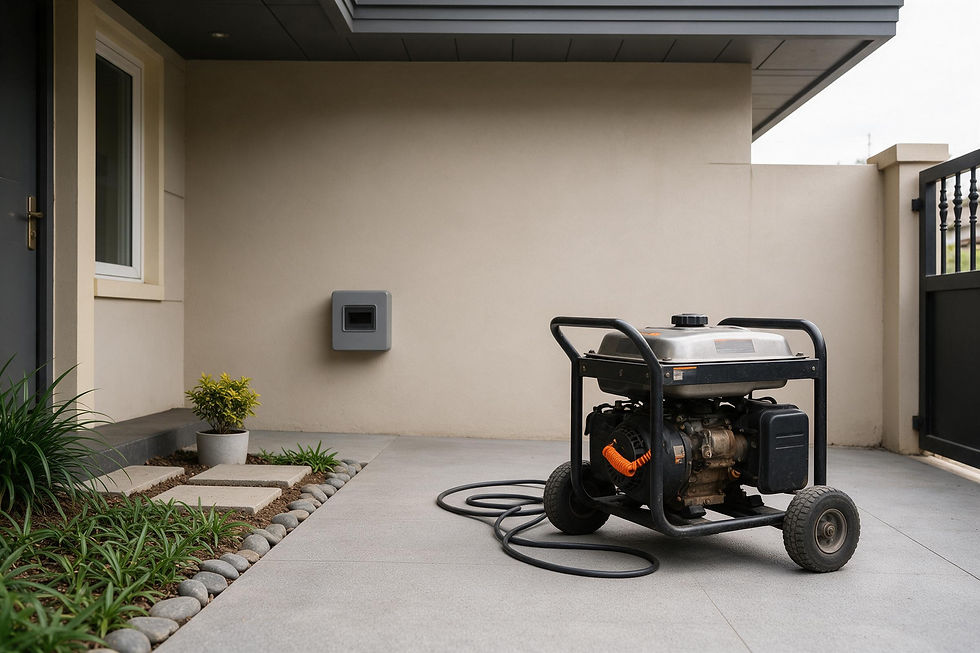
Plan the inlet, route, and operating area as one system.
Treat fumes as the first design constraint
The first question is not “Where is it easy to plug in?” It is “Where will exhaust not enter any occupied space?”
Portable generators produce dangerous exhaust. In Filipino homes, fumes can travel through more openings than people expect: jalousie windows, awning windows, sliding doors, vent blocks, open stairwell windows, dirty kitchen doors, maid’s room vents, lanai doors, balconies, and service-area openings. A generator can be outside and still be too close to the home.
Follow the generator manufacturer’s instructions on operating distance and clearances, and apply relevant safety guidance for exhaust separation. Keep the unit well away from doors, windows, vents, balconies, enclosed or semi-enclosed spaces, and neighboring openings. Direct the exhaust away from the house, away from people, and away from nearby structures where fumes can collect or drift back.
Avoid any location that behaves like an enclosure. This includes a closed garage, semi-enclosed carport, enclosed dirty kitchen, covered laundry cage, storage room, tight lightwell, or narrow side area with poor air movement. A carport may feel “open” because a vehicle fits there, but if a roof, boundary wall, gate, and house wall trap fumes, it is not a sensible generator operating area.
Also think beyond your own windows. In many subdivisions, townhouses, and dense city lots, one home’s side service strip faces another family’s bedroom, kitchen, or laundry opening. A generator placed close to the boundary can send fumes or noise toward the neighbor and then back into your own home depending on wind direction. Convenience for your inlet does not outweigh exposure to occupied rooms nearby.
A useful planning test is simple: if the generator runs for several hours at night, which room is most likely to smell it first? If the answer is a bedroom, dining area, helper’s room, home office, stairwell, or neighbor’s window, the location needs to change.
Keep storage shelter different from the operating location
Rain is a real issue in the Philippines, but rain protection must not turn into unsafe generator operation.
A portable generator should not be operated in rain or wet conditions unless it is protected by an operating cover or shelter specifically designed or approved for generator use. That cover must still preserve the manufacturer’s required exhaust, cooling, heat, ventilation, and combustible clearances. A normal roof eave, attached covered ledge, improvised tarp, cabinet, or generic canopy should not be treated as a safe operating solution just because it keeps water off the unit.
Separate two ideas in the plan: where the generator is stored and where it is safely operated. Storage may be in a dry, secure, ventilated area where the unit is protected when not in use. Operation must happen outdoors in the safe location required for exhaust and clearance, under conditions allowed by the manufacturer’s instructions. These two places may be near each other, but they are not automatically the same.
The common mistake is to build a neat cabinet or small shed for the generator and then run it there. That may hide the machine, but it can trap heat and exhaust. Portable generators are engines. They need air for combustion and cooling, and they release hot exhaust. A tidy enclosure can become the wrong kind of convenience.
Ground conditions also matter. Many Filipino service areas receive water from laundry, rain, car washing, downspouts, or garden runoff. The generator should not sit in a puddle, on shifting soil, or in the usual path of drainage. Plan a level, stable surface for moving and positioning the unit, while still respecting the required outdoor operating separation. The route should also remain usable when the floor is wet, because brownouts often happen during storms.
During typhoon season, the family may be tempted to use the generator in poor weather. The safer plan is to decide in advance when it can and cannot be operated, where it is stored, and what backup habits are needed if outdoor operation is not safe. A generator is useful, but it should not push the household into risky shortcuts.
Place the power inlet to stop extension-cord habits
The power inlet is the planned connection point between the portable generator and selected home circuits or transfer equipment. Its location should reduce improvisation, not encourage it.
A good inlet location lets the generator cord run outside, along a short and visible path, without crossing the main gate path, parking slot, wet laundry route, garden stepping stones, children’s play area, or walkway used by elders. During an outage, people move around with flashlights, phones, and sometimes food, water, or laundry. A thick cord across a dark path becomes a trip hazard very quickly.
At the same time, the inlet should be coordinated with the main electrical panel and transfer equipment by a qualified electrician. The generator should not be connected through makeshift backfeeding or random indoor outlets. The plan should make it clear which circuits may receive generator power and how the family switches safely between utility power and generator power.
The inlet does not always have to sit beside the main panel, but the two should be planned together. If the main panel is still being located, this guide on A Practical Main Electrical Panel Location for Filipino Homes is a useful next step because panel access, service routes, and generator planning often affect one another.
Avoid the habit of feeding extension cords through windows. It may seem acceptable during a one-time emergency, but repeated brownouts reveal the problems: insects enter, rain can follow the cord, windows cannot close properly, cords get pinched, and people trip. It also leads to a messy power strategy where the refrigerator, Wi-Fi, fans, chargers, lights, and work desk are handled one cord at a time.
A planned inlet also forces a healthier question: what really needs power? Many households prioritize the refrigerator, internet, a few lights, electric fans, charging points, a water pump if needed, and a selected work or study area. Heavy loads need careful assessment. Air-conditioning, electric showers, ovens, large pumps, and multiple simultaneous appliances may exceed what a portable generator can reasonably handle. The inlet location solves the cord problem, but load planning solves the daily-use problem.
Plan the route from storage to operation
A portable generator needs a place to stay when it is not running. If that place is inconvenient, the family may avoid the planned operating spot and use whatever corner is easiest during the blackout.
Storage should be dry, secure, and reachable. Some homeowners imagine the generator under the stairs, at the back of a bodega, behind cleaning tools, or inside a service room. That can keep the house tidy, but the real test is movement. Can one capable adult roll it out without lifting? Is there a ramp instead of steps? Is the path wide enough? Will it scratch interior flooring? Will it pass through the kitchen while people are cooking by emergency light?
The best storage-to-operation route is short, direct, and unremarkable. It should not cross the formal living area, block the front door, squeeze past the dining table, or require moving parked motorcycles every time. In many Filipino homes, the service side of the house is the most logical route because it already handles cleaning tools, laundry, LPG access, garbage movement, deliveries, and utility work. But that does not mean the generator can be placed carelessly there. The service zone is often already crowded.
Keep the generator away from LPG tanks, fuel storage, open flames, and food preparation areas. If the home has a dirty kitchen, outdoor sink, or service counter, avoid creating a setup where fueling happens beside cooking. Gasoline storage and handling need their own safe, controlled arrangement, especially in hot spaces and homes with children.
Security is also part of the route. A portable generator is valuable and movable. The operating area should be supervised and protected without putting the unit in an unsafe enclosed space. A lockable service gate, adequate lighting, and clear household rules can help. The front driveway may be visible, but it may also expose the generator to the street and force cords across the path of vehicles and visitors.

The route should be simple enough to use during a blackout.
Reduce noise without creating a dangerous enclosure
Generator noise is not just an inconvenience. It affects sleeping children, elders, helpers resting after chores, online meetings, and neighbors. In concrete neighborhoods, sound can bounce between boundary walls, carport ceilings, and hard paving. A location that seems acceptable in the afternoon may feel very different at 10 p.m.
Start by placing the operating area away from bedrooms as much as the safe exhaust requirements allow. Think vertically too. In a two-storey home, the generator may be on the ground but directly below a bedroom window, balcony door, or family hall opening. Sound rises, and vibration can travel through hard surfaces.
Noise control must not compromise ventilation or exhaust safety. Do not solve sound by putting the generator in a tight box, closed shed, or walled nook. Barriers, landscaping, orientation, distance, and thoughtful placement can sometimes reduce nuisance, but the generator still needs the clearance and airflow required by its manufacturer. The realistic goal is to reduce disturbance, not make the machine disappear.
Consider the household schedule. If outages usually happen in the evening, keep the generator away from dinner areas and sleeping zones where possible. If it supports work-from-home equipment during the day, think about the study, router, modem, and work desk. If an elder relies on comfort or medical-related equipment, plan the power path and room location carefully and seek appropriate professional advice.
Neighbors deserve the same consideration. Pointing exhaust and noise toward the next property’s bedroom wall, pocket garden, or service door can create tension. A well-planned home works not only inside the lot; it behaves better in the neighborhood.
Fit the generator into the whole utility map
A generator should not be planned as an isolated item. It belongs to the home’s utility map: main panel, service entrance, outdoor outlets, water pump, cistern or pressure tank if any, laundry, LPG, garbage, outdoor lighting, CCTV, gate controls, drainage, and service access.
The danger of planning utilities one by one is that the side yard becomes a crowded strip of unrelated equipment. The LPG tank needs ventilation and sensible separation from ignition sources. Garbage bins need access without smell entering the kitchen. Laundry needs airflow, drainage, and sun or covered drying strategy. The generator needs exhaust separation, outdoor operating clearance, a stable setup area, and a safe cord path. The electrical panel needs access and protection. All of these compete for the same practical zones.
For a home still in design, map the daily service movements before finalizing walls, windows, side gates, and counters. Where does trash move? Where does laundry go from washer to drying area? Where do deliveries enter? Where does rainwater flow? Where will someone stand while preparing the generator? Where will the cord run from the safe operating spot to the inlet? Which doors and windows are nearby?
Lighting is a small but important part of this map. During a brownout, the person setting up the generator may be working with a phone flashlight. A rechargeable emergency light, battery-backed security light, or clear access to a safe light source can reduce fumbling. If the house has cameras, gate controls, or internet equipment, decide which of these should be on backup circuits and whether the equipment remains reachable during an outage.
A generator is often part of a broader comfort and protection plan. The same thinking behind a Well-Protected Home applies here: small planning decisions can reduce avoidable stress when utilities fail.
Checklist before you finalize the generator location
Before approving the generator operating spot and power inlet, walk through the brownout scenario from storage to shutdown.
Where is the generator stored on ordinary days?
Can it be rolled out without lifting, passing through formal rooms, or blocking the main entrance?
Does the planned operating location meet the manufacturer’s required separation and applicable safety guidance?
Is it well away from doors, windows, vents, balconies, neighboring openings, and other occupied structures?
Is the exhaust directed away from people, the house, and nearby openings?
Is the area free from enclosure effects such as low roofs, tight walls, garages, covered cages, or trapped air?
Will the generator be kept out of rain and wet conditions, using only a cover or shelter specifically designed or approved for generator operation if needed?
Is storage shelter kept separate from the safe outdoor operating requirement?
Is the ground stable, level, and away from puddling or drainage paths?
Is the power inlet positioned to keep the cord short, visible, outside, and away from foot traffic?
Is the inlet coordinated with the main panel and transfer equipment by a qualified electrician?
Have the essential circuits been chosen realistically instead of trying to power the whole house?
Is the setup away from LPG, fuel storage, open flames, food preparation, and children’s play areas?
Will noise disturb bedrooms, the home office, or neighbors more than necessary?
Can the area be supervised and secured while the generator is running?
Is there enough light to set up and shut down safely at night?
A good generator location is not the nearest empty corner. It is the place where exhaust, rain, noise, cords, storage, security, and daily movement cause the least trouble while still meeting safety requirements.
For many Filipino homeowners, brownouts are frequent enough to plan for, but not constant enough to excuse risky shortcuts. The generator does not need a dramatic feature space. It needs a safe outdoor operating plan, a proper inlet, a practical storage route, and clear household rules.
Decide this early if you are renovating or building from scratch. Once windows, balconies, service doors, side gates, drainage slopes, and electrical panels are fixed, the remaining generator spot may become only the least bad option. Planned early, it can be accessible, organized, less disruptive, and far less likely to turn every outage into a scramble.

Walk through the full brownout routine before finalizing the plan.


Comments