

Where Should the Clothes Drying Area Go in a Filipino Home?

Short answer: place drying beside the service flow, not in the middle of it
For most Filipino homes, the best clothes drying area is a side or rear service zone directly connected to the laundry area, with open air on at least one side, some sun exposure, a roofed or partially roofed portion for sudden rain, good drainage, and a clear walking path that remains usable even when clothes are hanging. It should support the laundry route without becoming the route itself.
In simple terms: do not treat the sampayan as leftover space. In a good clothes drying area house plan Philippines setting, it is planned as part of the daily service movement: wash, carry, hang, retrieve, fold, and store. If the drying area forces people to squeeze past wet clothes to reach the kitchen, dirty kitchen, trash area, LPG storage, back gate, or carport, it will become annoying no matter how sunny it is.
The most practical location is often beside the laundry or dirty kitchen, along the side yard or rear yard, where it can get morning or afternoon sun and natural airflow. A partial roof, deep eave, canopy, or ventilated cover helps keep laundry usable during sudden rain. The walking route should remain open, and the clotheslines or racks should be placed to one side instead of across the path.
Zillvek Builders connects this kind of decision to customised home planning, because a drying area is not only an outdoor detail. It affects kitchen work, family routines, security, utilities, drainage, privacy, and long-term comfort. A home can look clean on paper but feel inconvenient if laundry movement cuts across daily life. Planning the service spaces with the same care as the main rooms is part of a practical Customised Design approach.
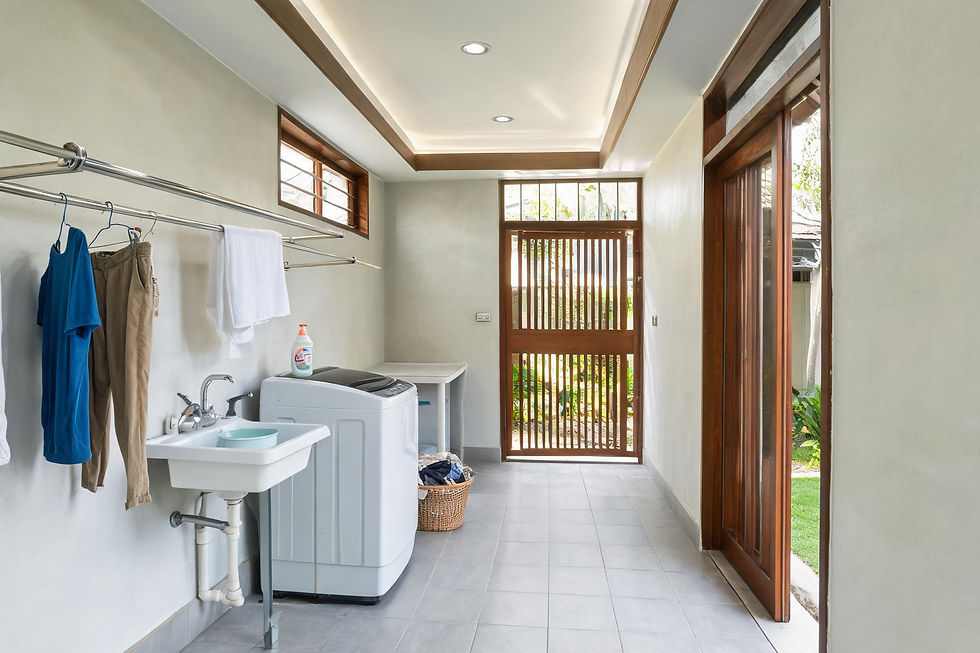
Drying works best when it supports the route instead of blocking it.
What the drying area must handle in a Filipino home
Laundry in the Philippines is not a once-a-week background task for many households. Uniforms, towels, pambahay, gym clothes, bedsheets, and rain-soaked items can pile up quickly, especially in homes with children, extended family, helpers, or people who commute daily. The drying area has to work with real weather and real movement.
Sun is useful, but sun alone is not enough. During hot months, direct sun can dry clothes fast, but during the rainy season or sudden afternoon showers, an exposed area can become frustrating. A drying space that gets drenched every time the sky changes will push laundry into corridors, bathrooms, bedrooms, railings, and carports.
Airflow is just as important. A shaded but breezy area can sometimes be more useful than a sunny but boxed-in corner. Clothes need moving air to dry properly and avoid that kulob smell. If the area is surrounded by high blank walls, solid gates, and closed windows, it may trap humidity even if it receives some sun.
Protection matters too. Many Filipino homes place service functions close together: laundry, dirty kitchen, water tank, pump, LPG, cleaning tools, trash bins, and sometimes a back gate. If the drying area blocks these, daily work becomes harder. A person carrying a laundry basket should not have to duck under wet sheets to reach the washing machine or squeeze beside a parked car to hang clothes.
Privacy is another local concern. In dense neighborhoods, townhouses, subdivisions, and narrow lots, the drying area may be visible from a neighbor's second floor, a side alley, or the street. The goal is not to hide the area completely, because it still needs air, but to use thoughtful screening, orientation, and height so personal laundry is not on display.
Best location options and when they work
There is no single perfect spot for every lot. The right placement depends on the lot orientation, house width, setbacks, family routine, and whether the home has a dirty kitchen, back door, side gate, roof deck, or upper balcony.
Side yard beside the laundry area. This is one of the most practical options when the lot has enough side space. It keeps wet work outside the main interiors and can connect directly to the wash area. The key is to keep the passage clear. Clotheslines should run along the side, not across the walkway.
Rear service court. A rear court works well if it receives light and breeze, and if it connects to the kitchen or laundry without passing through formal living spaces. It can also keep laundry out of the front view. The risk is that rear corners can become dark, damp, or crowded with utilities if not planned carefully.
Second-floor balcony or utility balcony. This can work for narrow lots where ground space is limited. It may get better sun and air than a tight ground-level side yard. However, it needs safe access, privacy, drainage, and a realistic carrying route. If every load of laundry must pass through bedrooms or a formal hallway, it may become inconvenient.
Roof deck drying zone. A roof deck can provide strong sun and airflow, but it needs protection from sudden rain and safe movement. It should not be the only practical option if elderly family members, helpers, or children will struggle with stairs while carrying wet laundry.
Covered utility nook with strong ventilation. In very tight homes, a partially enclosed drying nook may be necessary. It should not be treated like a sealed closet. It needs openings, exhaust support if appropriate, drainage, and space for racks without blocking doors.
The best choice is usually the one that balances four things: sun, air, rain protection, and movement. If one of those is missing, the space will likely fail in daily use.
How to get sun and airflow without losing rain protection
A common mistake is to choose between fully open and fully covered. For Philippine weather, the better answer is often partial protection: enough roof to keep the area usable during ambon or sudden rain, but enough openness for air and light.
A translucent or light-filtering canopy can help bring brightness into a side yard, but it should not turn the area into a hot, trapped greenhouse. Open sides, high vents, louvered panels, or gaps above privacy screens can let warm air escape. If the area has a roof, avoid sealing every side with solid walls.
For sudden rain, think about where water goes. Wet floors in a service area can become slippery and unpleasant. A proper drain location, practical floor finish, and a floor surface that is easy to clean will matter more in daily life than decorative treatment. The drying area should not send water toward the kitchen door, storage shelves, or electrical items.
Clothesline orientation also matters. Lines that run lengthwise along the service yard usually interfere less than lines stretched across the path. Wall-mounted folding racks, ceiling-mounted drying rods, or retractable lines can keep the area flexible. When the laundry is light, the path stays open. When the laundry is heavy, the space can expand without taking over the whole service zone.
If the area receives harsh afternoon sun, consider whether clothes, plastic hangers, and stored cleaning items will be exposed for long periods. A mix of sun and shade is often more comfortable for the person doing laundry. The best drying area is not only good for the clothes; it is also usable by the person who hangs, checks, and collects them.
Keep the kitchen, carport, and service path clear
The drying area should never become a daily obstacle course. In many homes, the service path is used for more than laundry. It may be the route for trash, groceries from the carport, water delivery, LPG replacement, garden tools, pet care, and access to a back or side gate. If wet clothes hang across that route, the house will feel poorly planned.
Start by imagining a normal busy day. Someone is cooking. Another person is washing clothes. A child needs a uniform. Rain clouds arrive. Groceries come in from the car. Trash needs to go out. If the drying area is placed in the wrong spot, all these small tasks collide.
The kitchen connection needs special care. Laundry should be near enough to be convenient, but it should not invade food preparation. Avoid placing dripping clothes where they block a kitchen door, cross a cooking route, or hang near open food work areas. If there is a dirty kitchen, the drying zone can be nearby, but it still needs separation from smoke, grease, and heavy cooking movement.
The carport is tempting because it has open air and roof cover, but it is rarely the best permanent drying area. When laundry occupies the carport, the car, bicycles, deliveries, and guests compete with wet clothes. It can also make the front of the home look cluttered. The carport may serve as an emergency rainy-day backup, but it should not be the main planned solution if another service location is possible.
Door swings and storage should also be checked. A back door that opens into hanging clothes will irritate everyone. A washing machine door, cabinet, or utility sink should be usable even when clothes are drying. The person carrying a full basket needs a direct path, not a narrow zigzag around racks, pails, and mops.
This is where a practical home plan earns its value. A Convenient and Comfortable Home is not only about bedrooms and living rooms. It is also about whether chores can happen without blocking the rest of the household.

The drying area should not interrupt cooking, carrying, or access.
Questions to settle before finalizing the location
Before fixing the drying area in the plan, ask questions based on actual household behavior, not only on what looks neat in a drawing.
Who usually does the laundry, and how far should they carry wet clothes?
Will the washing machine be indoors, semi-outdoors, or in a service area?
Does the family dry mostly uniforms and daily clothes, or also bedsheets, towels, curtains, and bulky items?
Is there a helper, elderly family member, or child who will use the area regularly?
Where does the sun hit in the morning and afternoon?
Which direction usually gets better breeze on the lot?
Can the area still be used during sudden rain?
Will clothes be visible from the street, gate, neighbor, or main receiving area?
Does the drying area block the route to the trash, LPG, pump, garden, or back gate?
Can the area be cleaned easily, with a floor and drain that make sense for wet work?
These questions prevent the common mistake of placing the drying area only after the main rooms are already fixed. Once the kitchen, stairs, bathrooms, parking, and setbacks are settled, the remaining service space may be too narrow or too dark. It is better to account for laundry early.
Small-lot adjustments that still work
Many Filipino homes deal with narrow lots, firewall conditions, close neighbors, and limited outdoor space. A small lot does not mean the drying area has to be chaotic. It means every part must work harder.
For a narrow side yard, keep one continuous walking strip clear and put drying fixtures on the wall side. Folding racks can be opened only when needed. Ceiling-mounted rods can keep the floor free, but they should be placed where hanging clothes do not hit faces or block doors. A small utility sink or washing area should not consume the only passage.
For a townhouse or compact urban home, an upper utility balcony may be a good compromise if it connects logically to the laundry area. If the washing machine is upstairs near bedrooms and bathrooms, an upstairs drying area may reduce carrying. If the washing machine is downstairs, an upstairs drying area may be less convenient unless the household accepts the stair movement.
For privacy, use breathable screens instead of solid enclosure whenever possible. Slatted panels, perforated blocks, metal grilles with plants, or high-level openings can soften the view while allowing air. A totally enclosed drying area may look tidy from outside but fail because clothes take too long to dry.
For homes that rely on indoor drying during storms, plan where temporary racks will go. The backup area should not be the main hallway, kitchen aisle, or foot of the stairs. A covered service area, ventilated balcony, or flexible utility corner is better than improvising every rainy week.
If using appliances such as a dryer or dehumidifying support, do not let that become an excuse for poor ventilation and poor layout. Mechanical help can be useful, but the house should still have a sensible place for air-drying items, wet towels, and hand-washed clothes.
A simple placement rule to remember
A good drying area sits beside the service route, receives sun and moving air, has partial weather protection, drains properly, and leaves the path open. If it fails any one of those, adjust the location, the cover, the fixtures, or the route before construction makes the problem permanent.
The sampayan should support daily chores, not announce itself every time someone cooks, parks, enters, or carries groceries.
When comparing possible locations, do not ask only, Where can clothes dry? Ask, What else must still happen here while clothes are drying? The answer will usually reveal the better spot.
If the side yard has light and breeze but is also the only service passage, place lines parallel to the wall and keep the walking strip clear. If the rear yard is private but dark, improve openings and avoid overbuilding the cover. If the roof deck is sunny but inconvenient, consider it a secondary drying zone rather than the only one. If the carport is the easiest covered space, use it as a backup, not the main plan.
The best location is the one that still works on an ordinary Monday morning, during a sudden afternoon rain, and on a weekend when the household is cooking, cleaning, parking, and receiving deliveries at the same time.

The right spot stays usable even when laundry is hanging.


Comments