

The Details Filipino Homes Regret Skipping Before Build Day
- David
- Jun 9
- 8 min read
On paper, the house looks finished. The floor plan is clean, the façade is elegant, and the renderings look like the kind of home you would proudly show relatives at a family gathering. But after move-in, the regrets start appearing in the quietest ways: the shoes pile up by the door, the laundry has nowhere sensible to dry, rainwater splashes where it should not, the air feels trapped in one corner of the house, and every family visit turns circulation into a small daily battle.
That is the part many homeowners only discover too late. In Filipino homes, the biggest frustrations are not always dramatic mistakes. They are usually the small things that were skipped before build day because they seemed minor compared with the tiles, the kitchen, or the façade. In reality, those small decisions shape how comfortable, private, and easy to maintain a house becomes for years.
If you are planning a custom home in the Philippines, especially on a tight urban lot or for a multigenerational family, this is where careful thinking matters most. A well-planned home is not just more attractive. It is less tiring to live in.
The small planning gaps that become daily annoyances
Many Philippine home planning mistakes begin with a simple assumption: “We can fix that later.” Later is usually when the walls are already up, the budget is tighter, and the everyday inconvenience has become permanent.
One common gap is storage. Homeowners often think of cabinets as a finishing detail, not a spatial priority. But Filipino households carry a lot of “invisible” items: school bags, umbrellas, slippers, water jugs, festival decorations, rice sacks, appliance boxes, extra bedding, cleaning tools, and emergency supplies. If storage is not planned early, these things end up in hallways, bedrooms, or the dining area. The house starts to feel smaller than it really is.
Another gap is the entry sequence. In many homes, there is no proper transition from outside to inside. That matters in a country where it rains often, footwear is removed before entering, and visitors may come and go throughout the day. A good entry area does not have to be large, but it should make sense. A dry spot for shoes, a place for umbrellas, and a buffer between the gate and the main living space can reduce clutter more than many people expect.
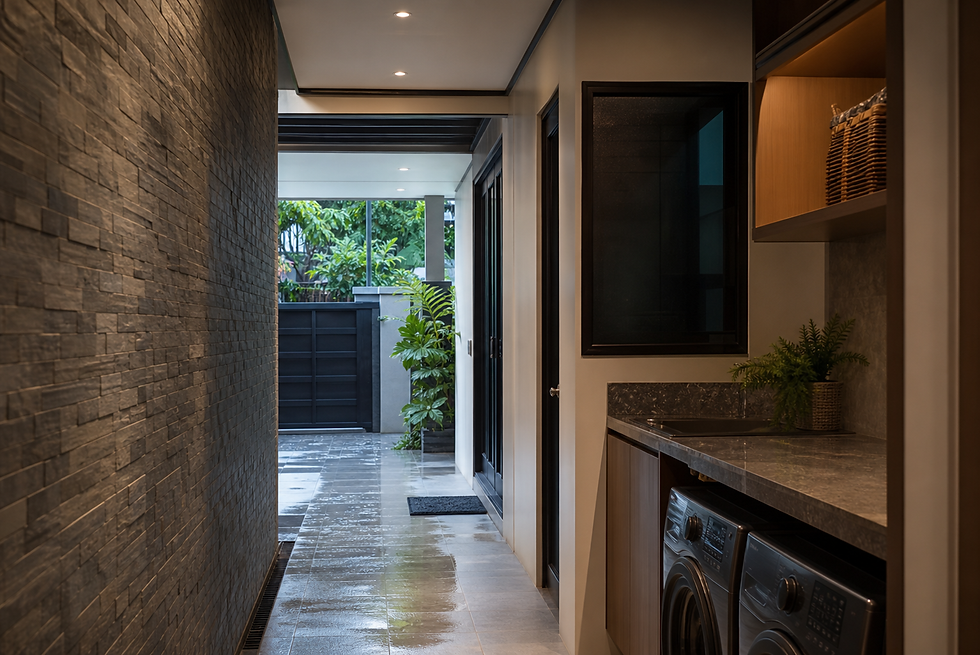
Then there is laundry. It sounds simple until you live with it. In the Philippines, drying clothes depends on sun, wind, and rain patterns, and many families do laundry several times a week. If the utility area is too hidden, too narrow, or too exposed, the routine becomes frustrating. A practical utility space is not glamorous, but it protects the home from the disorder that laundry can create when it has no proper place.
These are the details that separate a merely attractive house from a truly livable one. If you want a home that fits your day-to-day routine, not just your photo album, it helps to think in terms of customised design rather than copying a layout that looks good elsewhere.
Why Philippine conditions change what “good planning” means
A home that works in a temperate, spacious neighborhood may fail quickly in the Philippine context. Climate, lot size, family structure, and neighborhood density all change the equation.
Start with weather. Heat and humidity are not occasional issues here; they are constant design forces. If a home has poor airflow, deep interior spaces with no ventilation strategy, or rooms that depend too heavily on artificial cooling, daily comfort becomes expensive and fragile. That is why window placement, ceiling height, roof design, and cross-ventilation deserve as much attention as finishes. A house that breathes well simply feels better to live in.
Then consider rain. Heavy downpours, sudden storms, and prolonged wet months mean drainage cannot be an afterthought. Roof edges, gutters, slope directions, yard grading, and water discharge points need to be coordinated from the beginning. A beautiful exterior can still produce daily headaches if rainwater pools near the entrance, backsplash dirt stains the walls, or a poorly placed downspout interrupts a walkway. In many homes, one overlooked drainage detail becomes a recurring maintenance problem.
Lot size matters too. On dense urban lots, every meter has to work harder. Spaces cannot be planned as isolated rooms with no relationship to each other. You need circulation that respects how people actually move: from gate to entry, from kitchen to dining, from bedroom to bath, from service area to backyard, from carport to house. When these paths are awkward, even a large enough floor area can feel inefficient.
Family structure is another major factor. Filipino homes often support multigenerational living, guests from the province, or adult children who return home for periods of time. That means privacy cannot be treated as a luxury. Bedrooms need better separation, bathrooms need realistic access, and common spaces need to absorb family traffic without becoming chaotic. A room can be beautiful and still feel stressful if every conversation, television sound, or household routine carries into it.
For that reason, many families benefit from thinking not only about aesthetics but also about how the layout creates a beautiful well-planned home that responds to real use instead of idealized use.
Privacy is not only about walls
In dense neighborhoods, privacy is about more than fences and curtains. It is about how the house handles sightlines, sound, and daily exposure to neighbors and passersby.
A front window may look lovely in a rendering, but if it directly faces a neighbor’s second floor or the street, you may spend years closing curtains just to feel comfortable inside your own living room. A balcony may seem like a premium feature, but if it overlooks too much of the surrounding area, you might rarely use it. Even a strategically placed stair can either preserve privacy or create a visual corridor into the most sensitive parts of the house.
Sound matters just as much. In close-set communities, motorcycles, tricycles, roosters, karaoke, and neighborhood activity are part of the background. The layout should help buffer sleeping areas from noise and position shared spaces where liveliness is less disruptive. A well-thought-out home reduces the need to constantly react to the neighborhood outside.
Privacy also comes from how people enter and move through the house. A direct line from the gate into every major room can make a home feel exposed. A small change in the foyer, a screen wall, a turn in the hallway, or a more thoughtful arrangement of openings can create a much calmer experience without making the home feel closed off.
These are the kinds of choices that make a home feel secure and composed, which is why many homeowners eventually realize they needed more than just good looks. They needed a well-protected home that supports both comfort and peace of mind.
Circulation is the hidden comfort feature
People usually notice circulation only when it fails. Then it becomes obvious: two people cannot pass in the kitchen, guests block the hallway, the elderly family member has trouble moving safely, or the dining table interrupts the natural flow between rooms.
Good circulation is especially important in Filipino households because life rarely happens in neat one-person sequences. A parent may be preparing breakfast while a child gets ready for school and a grandparent moves toward the living area. Someone may be entering from the gate while another person is carrying groceries through the side door. When a house is planned well, these movements do not clash all the time.
Multigenerational living makes this even more important. Older family members may need shorter walking distances, less complicated bathroom access, and safer transitions between wet and dry areas. Children need space that is visible enough for supervision but not so central that the whole home feels noisy. Adults need rooms that can handle work-from-home tasks, care responsibilities, and household routines without turning every space into a multipurpose compromise.
One useful habit before build day is to mentally walk through a normal weekday. Where do you put groceries? Where do muddy shoes go during rainy season? Which path do you take at 6 a.m. when everyone is rushing? Which area becomes congested when relatives visit? If the house does not answer those questions elegantly, the inconvenience will show up later in the form of clutter and fatigue.
This is where a convenient and comfortable home becomes more than a phrase. It becomes the result of planning routes, thresholds, and everyday habits with care.
Utilities deserve a real plan, not a hopeful assumption
Utility planning is one of the most underappreciated parts of home design in the Philippines. Water pressure, power outlets, internet equipment, air-conditioning lines, service access, laundry drainage, and backup provisions all need a sensible location.
Many owners only think about where the appliances will sit, not where the services behind them will go. That creates problems later. A refrigerator placed without enough clearance can be hard to maintain. An air-conditioning unit with poor routing may require awkward repairs. Outlets placed too late in the process can force extension cords into permanent use. A router left in the wrong spot can weaken Wi-Fi in the very rooms where the family needs it most.
Water is especially important. In many parts of the Philippines, families need practical thinking around tanks, pumps, hose points, and drainage. A home should make maintenance easy, not require a technician for every small issue. If access panels, service routes, and wet-area details are planned early, the house becomes easier to care for over time.
Even lighting is part of utility planning. Natural light is valuable, but it should be balanced so that rooms do not overheat or glare. Evening lighting should support reading, cooking, studying, and security without forcing the whole house into one harsh brightness level. These are small decisions individually, but they change the mood and function of the home every day.
Future-proofing is cheaper than fixing regret
Homeowners often underestimate how quickly needs change. A child becomes a teenager. Parents begin working from home more often. An elderly relative moves in. A business starts in one room. A car changes size. A new appliance needs a different outlet or stronger utility support. What seemed sufficient at the time of planning suddenly feels too rigid.
Future-proofing does not mean overbuilding. It means leaving intelligent flexibility. That may include extra conduit paths, enough structural planning for possible adjustments, storage that can evolve, or a room that can shift function without major reconstruction. In Philippine homes, where family needs often change with little warning, flexibility is not a luxury. It is one of the most practical forms of savings.
Security is part of future-proofing too. Gates, windows, lighting, and visibility should be planned as part of the home’s daily life, not only as separate add-ons later. A house that can be secured without feeling fortress-like usually gets used more comfortably. People relax when the home feels both open and protected.
The best planning is often the kind you barely notice after move-in because it quietly prevents friction. That is the standard worth aiming for: not a dramatic house, but a house that remains easy to live in as life changes around it.
A better pre-build checklist for Filipino homeowners
If you are still in the design stage, use these questions before you finalize the plan:
Where will wet shoes, umbrellas, and everyday bags go after entering the house?
How will laundry dry during rainy months without disrupting the home?
Does the house naturally move people from public to private spaces?
Can older family members move around safely and comfortably?
Are windows, openings, and outdoor-facing rooms placed with privacy in mind?
Have drainage, roof runoff, and maintenance access been planned, not assumed?
Where will internet, security devices, and essential utility equipment be placed?
Can the layout adapt if family needs change over time?
These questions may seem less exciting than choosing tiles or countertop finishes, but they affect your daily life far more often. A home is experienced in routines, not renderings.
If your goal is long-term comfort, start with the details that are easiest to ignore before build day and hardest to change afterward. That is usually where the smartest homes are made.
Build for the life you actually live
The most practical Filipino homes are not necessarily the grandest. They are the ones that understand how people really live: with rain, heat, guests, aging parents, school routines, errands, deliveries, security concerns, and the constant motion of family life. When those realities shape the design early, the house becomes easier to maintain and more pleasant to inhabit.
So before construction begins, slow down long enough to look at the details that rarely get posted online but are felt every single day. Storage, circulation, privacy, utilities, drainage, and flexibility are not minor concerns. They are the hidden structure of comfort.
If you plan them carefully now, you are not just avoiding mistakes. You are building a home that respects the way Filipino life actually works.
— David


Comments