

The Service Door Should Not Become the Main Entrance
- David
- 1 day ago
- 5 min read
The problem usually shows up on an ordinary day. The groceries come in while it is raining, the delivery rider is waiting, someone is carrying wet laundry, and the only workable path is through the nicest part of the house. Suddenly the “beautiful” entrance becomes a bottleneck, and the real service route feels like an afterthought.
In many Filipino homes, this is not a small inconvenience. It becomes a daily pattern. The service door, laundry access, utility corner, and back circulation quietly end up doing the work of the main entrance because the house was planned around what looks good in photos, not around how families actually move.
That is why Customised Design matters so much in custom home planning Philippines. A well-designed house should not force deliveries, trash runs, muddy shoes, helpers, children, and family members into the same polished route every day. It should separate display from function without making the home feel fragmented.
The daily friction homeowners notice
Most homeowners do not think about service circulation until the house is already being used. Then the friction becomes obvious:
The groceries cross the living room because the kitchen entry is too narrow.
Wet umbrellas and rain-soaked bags drip through the nicest floor finish.
Laundry has to pass through guest spaces just to reach the utility area.
Trash storage sits too far from the exit, so it becomes awkward and unpleasant.
Deliveries require someone to open the front door, step aside furniture, and interrupt the whole household.
These are not dramatic failures. They are the kinds of small annoyances that slowly make a house feel tiring. In a tropical country, they are amplified by rain, humidity, and the reality that many days begin and end with things being carried in and out.
For Filipino families, the issue is also social. Some homes regularly receive food deliveries, online shopping, school items, helpers carrying supplies, and relatives arriving with bags in hand. When the house has no practical service path, everyone feels it. The home becomes less calm, less private, and less efficient than it should be.
Why this matters in Philippine homes
In the Philippines, home planning has to respond to real conditions. Rain is sudden. Streets can be narrow. Parking can be tight. Neighbors are close. Household help may need clear working routes. Multigenerational families may share one front entry all day. These are not edge cases; they are normal life.
A strong layout respects those realities. It keeps muddy or wet movement away from clean interior zones. It gives deliveries a sensible handoff point. It lets laundry and trash move out without crossing formal living areas. It supports privacy, especially in dense neighborhoods where every opening feels exposed. It also reduces visual clutter, because storage and utility work are handled where they belong instead of being improvised in hallways.
This is where a house starts feeling premium in a grounded way. Not because it has more decorative space, but because the routine tasks are easy. A good home design feels quiet when you use it. That quietness is often the result of careful planning, not expensive finishes.
For a deeper look at how a home can feel both refined and usable, see Beautiful Well-Planned Home and Convenient and Comfortable Home. Both ideas matter because comfort is not only about style. It is also about circulation, access, and the way a home handles everyday work.
How better custom planning solves it
Better planning starts by asking a simple question: which routes are used every day, and which routes are only for guests? That distinction changes the entire house.
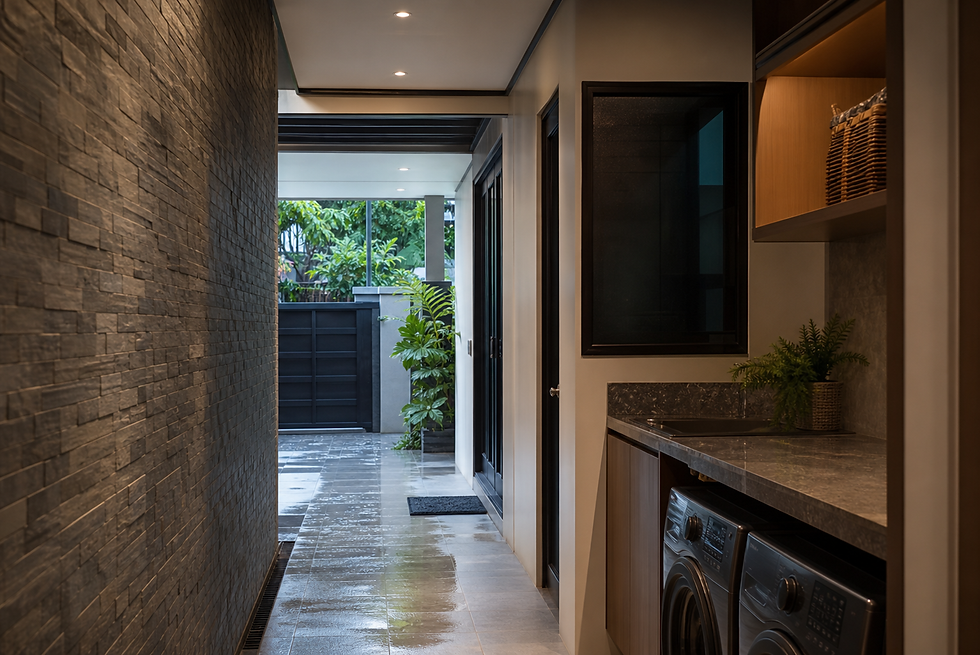
A practical custom home can include a service entry that connects naturally to the kitchen, pantry, laundry, or utility area. That route does not need to be hidden in a cramped corner. It just needs to be intentional. If it is planned well, the front entrance can remain gracious for guests while the back or side access handles daily movement with less friction.
Useful planning details include:
A covered service path so rain does not control the routine.
A mud-friendly landing zone for wet shoes, umbrellas, and bags.
Direct access from the service door to storage, kitchen, or laundry.
A discreet trash holding area that does not pass through the main living space.
Enough turning space for carrying laundry baskets, grocery bags, and appliances.
Clear separation between guest-facing and utility-facing circulation.
These details may sound modest, but they have outsized impact. They reduce cleaning, protect interior finishes, and make the household easier to run. They also make it more comfortable for everyone, including children, older family members, and helpers who need to move safely and efficiently.
Zillvek Builders approaches homes with that kind of practical intelligence. In its worldview, a premium home is not one that merely photographs well. It is one that works gracefully for the family living inside it. That means thinking through service paths, storage logic, privacy, and daily routines before construction starts. It is the difference between a house that performs on day one and a house that keeps performing years later.
You can see that mindset reflected in Actual Projects, where practical planning is treated as part of the architecture rather than an afterthought. The same approach is what makes Zillvek Builders relevant to homeowners who want something more grounded than generic showroom design.
Where the service door belongs
The service door should support life, not dominate the house. In many homes, it works best when it is visible enough to be convenient but discreet enough to preserve the calm of the main spaces. It should connect to the tasks that happen most often: deliveries, laundry, cleaning, storage, garden access, pet care, or staff movement.
It should also reflect how the household actually lives. A family that receives frequent packages needs a different entry logic from a family that hosts older parents or keeps a helper on-site. A home with children needs a safer route for wet items and school bags. A home in a dense urban setting may need more privacy control and better separation from the street.
When those needs are considered early, the service door becomes a strength. It keeps the home ordered. It reduces conflict between beauty and function. And it lets the front of the house remain what it should be: welcoming, calm, and not overloaded with daily labor.
Plan the hidden routes before construction
Most regrets in house planning come from the things no one drew clearly enough. Service circulation is one of those things. Once walls are up and finishes are chosen, it is expensive and frustrating to correct a route that should have been designed from the start.
That is why this conversation belongs in the earliest stage of Filipino home design. Before choosing tiles, lighting, or façade details, map the daily movements: where groceries enter, where wet items go, where trash exits, where laundry dries, and how the household handles visitors versus service tasks. If those paths are clear, the house will feel more composed every day.
Zillvek Builders plans around that reality. The goal is not to make every practical element disappear. The goal is to make the home feel effortless because the practical parts were designed with care. That is what separates a merely attractive house from one that stays comfortable, efficient, and dignified over time.
If you are planning a custom home, do not let the service door become the main entrance by accident. Design the routes now, while they are still easy to shape, and your future home will be quieter, cleaner, and more livable in the ways that matter most.


Comments