

The Laundry Should Dry Without Taking Over the House
- David
- Jun 13
- 6 min read
In a lot of Filipino homes, laundry does not stay in one place. It spreads. Wet shirts hang on stair rails, uniforms occupy bedroom doors, towels end up on dining chairs, and the hallway starts looking like a temporary drying line. On a dry day, that is inconvenient. During the rainy season, it becomes a house-wide climate problem.
The frustrating part is that this is often treated as a housekeeping issue when it is really a planning issue. If your home has limited service space, weak airflow, or no clear route for wet clothes, the laundry area will keep invading the rest of the house. You will feel it in the damp smell, the extra clutter, the slippery floors, and the constant rearranging of shared spaces. In a tight lot, in a dense neighborhood, or in a multigenerational home, that disruption multiplies fast.
That is why laundry should be designed as part of the house’s operating system, not as a leftover corner. When Zillvek Builders looks at utility spaces, the question is not only where the washing machine fits. The real question is how wet work moves through the home without disturbing comfort, privacy, or circulation. That is the difference between a laundry area that behaves and one that slowly takes over everything around it.
Why laundry becomes a house-wide problem in humid Philippine weather
In the Philippines, drying clothes is never just about sunlight. Humidity can hang in the air long after the rain has stopped, and a covered but poorly ventilated area can leave garments smelling half-dry, half-stale. If the service area opens awkwardly into the kitchen, dining room, or main hall, moisture does not stay in one zone. It travels.
This matters even more in homes where the laundry load is continuous. School uniforms, workwear, sports clothes, towels, bedding, and linens all cycle through the same routine. In multigenerational households, the volume is higher and the timing is messier. Someone is always washing something, and someone else is always trying to keep the living room clear for visitors or the children’s play. A laundry setup that works only when conditions are perfect is not a functional setup at all.
That is why a practical home in this climate needs more than a washing machine tucked beside a wall. It needs a service area that can handle wetness on purpose. This is the kind of detail that belongs in a Customised Design approach, because different families, lot shapes, and adjacency conditions call for different solutions. What works on a wide suburban lot will not necessarily work on a narrow urban property with neighboring windows close by and no spare side yard.
The layout moves that keep wet work contained
The strongest laundry spaces are rarely the biggest ones. They are the ones with the cleanest sequence.
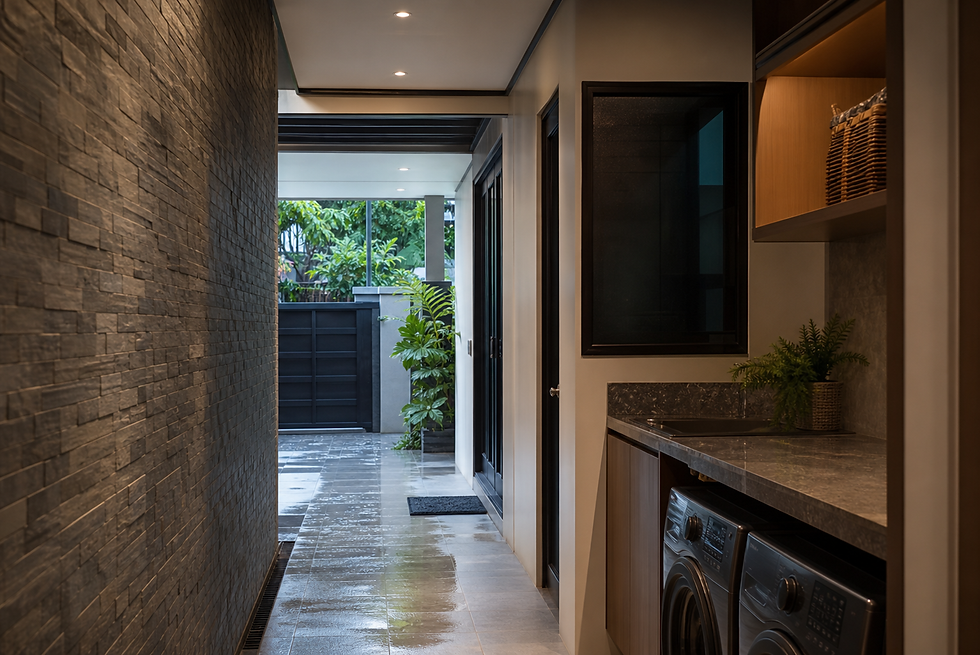
Start with access. If clothes move from washing to drying to folding without crossing the entire house, you have already removed half the friction. A covered path or service-yard connection makes a big difference, especially when rain arrives suddenly. You do not want family members carrying dripping baskets through finished interiors just to reach a drying rack.
Then think about airflow. Cross-ventilation is not a luxury in laundry design. It is what helps clothes dry faster, keeps walls from holding moisture, and reduces that enclosed smell that creeps into nearby rooms. Openings, louvers, high vents, and a layout that allows breezes to move through the area can do more than extra fans alone. In a well-planned home, the laundry zone should feel like a place that lets air pass through, not a pocket where humidity gets trapped.
Drainage is the next quiet hero. A floor drain, proper slope, and washable surface make a service area much easier to maintain. Wet floors will happen. Water will drip from baskets, machines, and rinsed items. If the space cannot handle that mess gracefully, the mess will move elsewhere. A utility sink is equally useful here, because it gives you a place to pre-soak, hand wash, or rinse items without sending water through the kitchen or bathroom. This is one reason utility planning should be considered alongside fixtures like a Modern Kitchen Sink—not because the rooms are the same, but because practical water use works best when the whole house is coordinated.
Storage is the final piece people forget. Hampers, detergents, pegs, stain removers, drying clips, ironing tools, and spare baskets all need a home of their own. Without that storage, laundry becomes visual clutter before the clothes are even dry. Open shelves can work if they are tidy and protected, but enclosed cabinets or built-ins usually make the service area feel calmer and less exposed.
These are simple choices, but together they keep the laundry contained. They also make the rest of the house feel more finished. That is the point of a Beautiful Well-Planned Home: the practical parts do not have to look improvised.
Rainy season changes the rules
The rainy season in the Philippines exposes weak laundry planning immediately. A space that seemed fine in March may feel impossible in July. Drying time stretches. Floor areas stay damp longer. Clothes may need to be moved twice because a storm rolled in halfway through the afternoon. If the laundry area is exposed, you are constantly negotiating with weather instead of simply living.
This is where covered drying becomes valuable. Covered does not mean sealed. The goal is not to trap clothes in a box; the goal is to protect them from rain while still allowing air movement. A roofed service area with open sides, screened openings, or an airy layout gives you more reliability without sacrificing ventilation. It also helps preserve privacy in dense neighborhoods, where a full view of the family’s laundry from the street or next door is not always ideal.
Privacy is not only about appearances. In closely packed communities, people often design walls or makeshift covers that block sightlines but accidentally block air too. That is how laundry areas become hot, stale, and slow. A better answer is to plan the service zone so it is discreet without being sealed off. The best laundry areas feel practical and unremarkable, which is exactly what they should be.
For families planning a custom home, this is where professional thinking matters. Zillvek Builders treats these service details as part of the home’s daily performance, not as decorative extras. When a laundry area is planned early, you can shape the structure around real weather patterns instead of trying to patch the problem later with improvised racks and tarps.
Multigenerational homes need fewer bottlenecks
In a household with grandparents, parents, kids, and sometimes helpers or caregivers moving through the same day, laundry has to stay out of the way. Bottlenecks are what make a home feel tiring. A basket left in a passageway, a drying rack placed where someone needs to pass, or a washer door that swings into the wrong circulation path can turn a small task into a daily annoyance.
The laundry area should support this kind of shared life with clear movement. You want space to sort, wash, carry, dry, and fold without blocking the kitchen, the back door, or the route to the bathroom. If the home has a service entrance, that route should be simple and direct. If it does not, then the laundry zone needs to be even more intentional so wet work does not collide with family movement.
This is where a Convenient and Comfortable Home is not a slogan but a planning standard. Convenience means the person doing the laundry does not have to improvise every step. Comfort means the rest of the family does not have to live around the side effects of laundry all day. When those two things are designed together, the house feels calmer without looking larger.
For families in the Philippines who are thinking seriously about long-term livability, this is a small but important lesson: utility space is family space. A laundry area that is easy to use, easy to clean, and easy to keep out of sight protects the whole rhythm of the home.
The best laundry areas feel quiet, not temporary
People often think of the laundry zone as a leftover. In practice, it is one of the most active spaces in the house. It handles water, heat, damp air, detergent, dirty textiles, and constant movement. If it is poorly planned, those elements spread into the rest of the home. If it is well planned, the laundry disappears into the background and the house stays livable even when the weather is not cooperating.
That is the real standard worth aiming for. Not a dramatic laundry room. Not a showroom solution. Just a service area that works hard without making the house feel busy.
When you design a Filipino custom home, treat the laundry as infrastructure. Give it airflow, drainage, storage, privacy, and a direct route that makes sense for your family’s routine. Think through rainy months, small lots, and shared household use before the walls are built, not after the first damp week forces a compromise. That is the kind of practical planning Zillvek Builders values: homes that respect ordinary life and make it easier to live.
If the laundry can dry without taking over the house, the whole home feels better. Less dampness. Less clutter. Less noise from the things that should have stayed in one place.
Related Zillvek Builders guides
These related pages help connect this topic to the rest of the Zillvek Builders website:
Cost-Efficient Home — Supports the case for planning laundry efficiency into the home instead of adding piecemeal fixes later.


Comments