

Planning a Filipino Home for a Family Member with Hearing Loss

Planning a home for a relative with partial hearing loss or deafness requires shifting from an acoustic-first layout to one centered on clear sightlines, balanced lighting, and visual or tactile alerts. In a typical Philippine house—where concrete hollow-block walls and polished porcelain tiles bounce sound, street gates sit dozens of paces from the front door, and seasonal typhoons knock out grid power—standard doorbells and audio alarms often leave a hard-of-hearing family member isolated or caught unaware.
A practical home design for hearing loss balances safety, easy daily interaction, and personal privacy. That means establishing clear visual connections between rooms without making private quarters feel exposed, wiring multi-zone strobe or visual indicators for visitors and emergencies, managing tropical glare so lip reading and sign language feel natural, and softening the harsh acoustics of everyday tile and masonry.
Visual and Multimodal Visitor Alerts
In many Philippine subdivisions and barangays, perimeter gates and deep carports separate the public roadway from the main entrance. When a courier arrives, a visitor presses an intercom, or relatives stop by unannounced, relying on a standard acoustic chime simply does not work for someone with hearing impairment.
Effective visitor notification relies on multi-zone, layered alerting:
Flashing visual indicators in high-use rooms: Integrate synchronized visual indicators or LED chime units in the main living space, kitchen, family TV area, and the family member's bedroom. Soft pulse alerts avoid the jarring effect of high-intensity strobes during normal daylight hours.
Direct smartphone or wearable vibration: Low-latency Wi-Fi or local radio frequency doorbells that send instantaneous push notifications or vibration pings to smartwatches allow freedom of movement anywhere on the lot, including utility yards or service lanai areas.
Visible entry monitors: Placing video monitors near common sightlines lets the resident immediately identify who is at the pedestrian gate without needing an audio exchange. When planning placement, reviewing where should a gate intercom or video doorbell be placed ensures outdoor units capture clear face angles under direct tropical sun or heavy rain.
When relying on cloud-connected smart alerts, neighborhood internet disruptions or broadband dropouts during storms can interrupt notifications. Selecting equipment that supports direct, local signal transmission—whether via low-voltage cabling or dedicated local radio frequency links—helps visitor chimes and visual beacons function independently of internet access, provided there is continuous power supply and adequate wireless range across masonry walls.

Visual chimes and entryway monitors provide clear visitor notifications without relying solely on sound.
Life Safety and Emergency Notifications During Brownouts
A critical concern for any household is life safety during sudden emergencies. Standard audible alarms may not be perceived reliably, particularly during deep sleep, when background noise from heavy rain or cooling fans masks the sound, or when hearing aids and cochlear processors are removed for the night.
Comprehensive emergency planning must account for both day and night scenarios:
Interconnected visual notification devices: Rather than relying on sound alone, life-safety layouts link detectors so that when an alert triggers in one zone, compatible visual notification appliances illuminate across occupied spaces and sleeping quarters. Cooking spaces, including indoor kitchens and dirty kitchens, require appropriately selected detector types—such as dedicated heat detectors rather than standard smoke alarms that trigger false alerts from sautéing oil or cooking steam—with placement planned according to equipment instructions and qualified fire safety advice. In bedrooms and hallways, compatible visual strobes should be selected to match room dimensions and ceiling heights rather than assuming a single fixture fits every room.
Compatible tactile bed shakers: For nighttime peace of mind, sleeping rooms benefit from tactile notification equipment engineered specifically for emergency waking and explicitly certified to work with the chosen alarm system. Automatic activation depends on the supported interconnection method, the specific control module or auxiliary power supply, and professional installation. The complete notification chain—from sensor detection to bed shaker activation—must be regularly tested, including under primary and battery backup power, rather than assuming generic vibrating pads will respond to any bedroom alarm.
Emergency power redundancy: Typhoons and power interruptions are common across the country. Standby battery backup should cover not just emergency lamps, but also the visual notification relays and vibrating alarms. Weighing choices such as fixed emergency lights or rechargeable lamps for home brownouts helps families organize emergency lighting along hallways, doors, and stair runs, though dependable lighting during extended grid failures still depends on proper fixture positioning, fresh battery capacity, routine testing, and runtime limitations.
Homeowners considering communication and alert needs may want to discuss them through Zillvek Builders' Customised Design service, since customised home design should respond to the household's routines, comfort, protection, and long-term use.
Lighting and Sightlines for Face-to-Face Communication
Visual communication—whether through speech reading, facial cues, or Filipino Sign Language (FSL)—requires clean, glare-free sightlines. A poorly illuminated room or a window directly behind a speaker turns faces into dark silhouettes, making lip reading exhausting over prolonged conversations.
Controlling Tropical Backlight and Glare
Strong midday sunlight pouring through unshaded glass creates extreme visual contrast. To support effortless visual communication:
Position family seating perpendicular to primary windows rather than directly in front of them, so natural daylight falls evenly across faces rather than silhouetting the speaker.
Use deep eaves, outdoor awnings, or sheer interior curtains to diffuse harsh tropical daylight into soft, ambient illumination across dining and living areas.
Choose matte or satin interior paint finishes and avoid high-gloss table surfaces that reflect blinding reflections from ceiling downlights.
Open Sightlines and Widened Corridors
Abrupt right-angle hallway corners and solid partitions create blind spots where family members can easily startle each other. Designing wider corridors (at least 1.1 to 1.2 meters) and open circular transition zones allows people to walk side-by-side while signing or talking without bumping into door jambs or furniture. Low-profile half-walls, glass partition inserts, or wide pocket doors help maintain visual connection between the primary kitchen and sala without sacrificing structural boundaries.

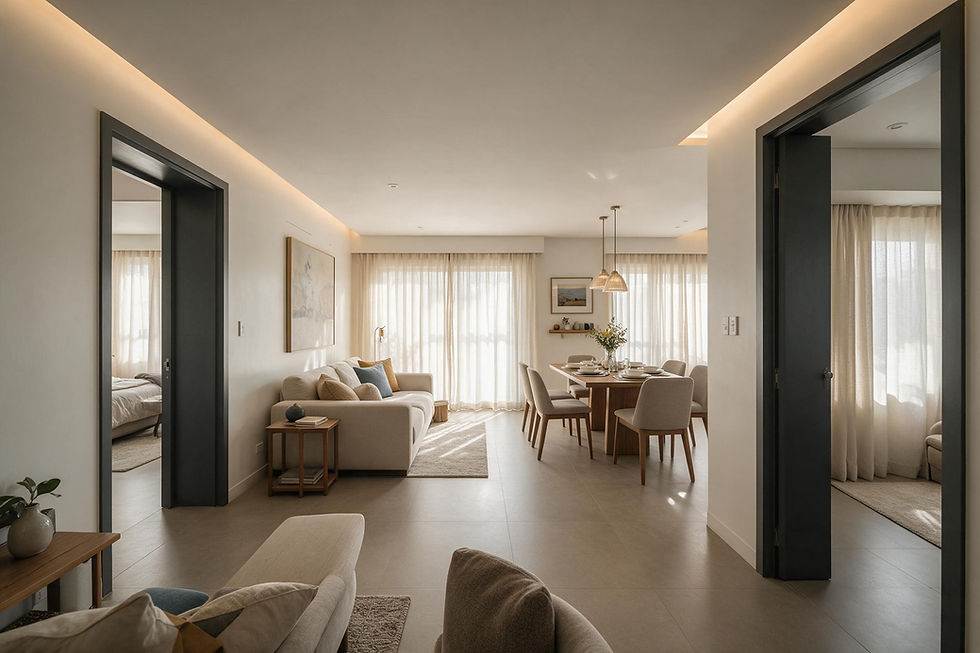
Diffused tropical daylight and open seating arrangements eliminate harsh glare and support easy lip reading.
Controlling Echo and Hard Surface Reverberation
While deaf family members rely heavily on visual cues, individuals with partial hearing loss or those using hearing aids often struggle in typical Philippine interiors. Concrete masonry, large glass panes, and glossy porcelain tiles create significant reverberation. Reflected echoes blur consonant sounds and cause hearing aids to amplify background clatter—such as metallic pots clattering in the dirty kitchen or an electric fan motor hum—over spoken voices.
Practical acoustic interventions that suit the humid Philippine climate include:
Engineered acoustic ceiling assemblies: Decorative textured ceiling plaster does not meaningfully absorb sound. Instead, effective overhead sound control relies on tested acoustic plaster systems engineered with open-pore binders, or moisture-resistant perforated gypsum ceiling assemblies and slatted timber panels fitted with sound-absorbing backing materials, such as density-rated acoustic fleece or mineral wool infill.
Fabric and soft furnishings: While heavy wall-to-wall carpeting is impractical in hot, humid climates prone to dust mites, strategically placed washable area rugs, upholstered dining chairs, fabric sofas, and lined window drapes dampen mid-frequency speech flutter.
Quiet appliance selection: Inverter split-type aircon units with low indoor decibel ratings reduce continuous background drone, making it significantly easier for hearing aid users to distinguish conversations without listener fatigue.
Balancing Visual Connection with Personal Privacy
A common mistake when designing for hearing accessibility is eliminating too many interior boundaries, leaving the family member feeling as though they are always under surveillance. Every person needs private sanctuary where they can unwind without feeling observed.
In bedrooms and personal en suite bathrooms, privacy can be preserved without compromising safety:
Visual entry indicators: Instead of knocking repeatedly on a closed door—which the occupant cannot hear—install a gentle bedside or desk indicator light wired to a push switch outside the bedroom door. A quick press flashes a soft amber light inside, signaling that someone is requesting entry.
Frosted clerestory glass or obscured side-lites: Narrow frosted glass panels beside interior doors allow an occupant to see the shift of a shadow or approaching silhouette in the hallway before the door opens, preventing the unpleasant shock of someone suddenly entering their peripheral vision.
Controlled sightlines: Angle personal study desks and beds so the occupant faces toward the doorway rather than having their back turned directly to the entrance.
Designing a home for a family member with hearing loss ultimately comes down to deliberate spatial awareness: eliminating visual blind spots, calming noisy acoustic reflections, wiring dependable visual alerts, and honoring each person's independence and privacy under one roof.

Frosted side panels and courtesy call lights offer occupants privacy while preventing surprise entries.


Comments